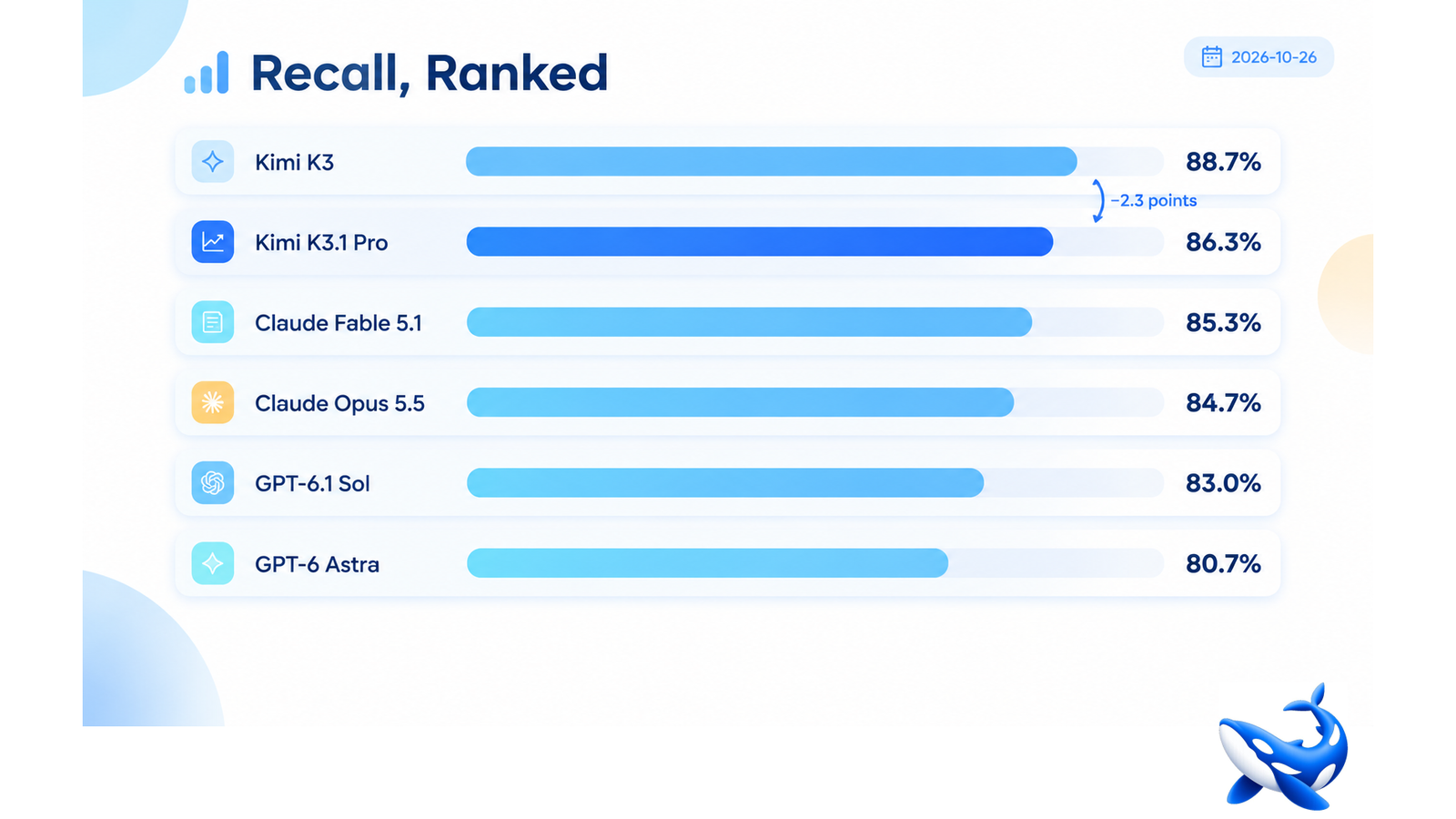

The most interesting row in Kimi K3.1 Pro’s benchmark sheet is one the launch did not lead with. On AA-LCR, long-context recall, it scores 86.33% — ahead of every frontier competitor we can compare it to, including Claude Fable 5.1 at 85.33%, Claude Opus 5.5 at 84.67%, GPT-6.1 Sol at 83.00% and GPT-6 Astra at 80.67% [INDEPENDENT, index v4.3.2, 26 October]. It also trails its own predecessor, Kimi K3, at 88.67% on the same evaluation. The OrcaRouter card for Kimi K3.1 Pro reproduces the 86.33% figure alongside the four frontier rows, at the vendor’s list price with no markup, which is where the odd shape of the result becomes visible: first in the field, second in the family.
For anyone buying a long-context model, that is more useful than the composite index. The composite tells you a model is good on average. The recall row tells you whether a million-token window is usable or decorative.
The ranking
| Model | AA-LCR |
| Kimi K3 (Max) | 88.67% |
| Kimi K3.1 Pro | 86.33% |
| Claude Fable 5.1 (Max) | 85.33% |
| Claude Opus 5.5 (Max) | 84.67% |
| GPT-6.1 Sol (Max) | 83.00% |
| Claude Sonnet 5.5 | 82.67% |
| GPT-6 Astra (Max) | 80.67% |
| Gemini 4 Argon (High) | 79.67% |
| GLM-5.3 (Max) | 79.67% |
| Grok 4.7 (Xhigh) | 76.67% |
A 10-point spread across the field, with the Kimi line occupying the top two slots. The second-place-in-the-family result is not a scandal; it is the normal consequence of a post-training run that was optimised for something else. The composite went from 43.59 to 55.09 across the same release. Recall gave up 2.34 points while reasoning gained twelve. If you have to trade, that is the trade most teams would take.
What a recall benchmark measures, and why it differs from a context window
A context window is a physical limit: how many tokens the model can accept. Recall is a behavioural measurement: given a long input, does the model find and use a specific piece of information in it?
Those come apart constantly. Models with 1M-token windows routinely score below 80% on long-context recall, which means the last few hundred thousand tokens are addressable in principle and unreliable in practice. The failure is quiet — the model answers confidently using whatever it did attend to — and it is the single most common cause of “the model ignored the document I gave it”.
AA-LCR is built to expose that: multi-document questions where the required evidence sits at a distance inside a long context, scored on whether the answer reflects the right passage. An 86.33% is a strong result, and it is the specific number to cite when someone asks whether a 1M window on this model is real. It is: 86% of probes, real.
The remaining 14% is where engineering goes. Two habits that follow directly:
Put the question’s evidence at the edges. Recall is not uniform across a long context; material in the middle is the classic weak spot. If you control the prompt, place the instruction at the front and the payload immediately before the question, and keep the bulk in the middle.
Keep a retrieval step for precision work. A recall layer that narrows a million tokens to ten thousand before the model sees them turns an 86% problem into a 95% one at a fraction of the cost, because you pay for 10K tokens of input instead of 1M. Long-context models and retrieval are complements, not competitors.
See also: Building a Group Booking and Event Block Management Module for Hotels
Why the new model’s recall dropped
Nobody has published an ablation, so the honest answer is that we do not know. Three plausible mechanisms are worth knowing because they predict how the next release will behave.
Post-training shifts attention. Moonshot describes K3.1 Pro as a post-trained version of K3 with substantially larger post-training compute, including large-scale joint reinforcement learning across hundreds of domains [VENDOR]. RL on task outcomes rewards behaviours that produce correct answers, not behaviours that attend uniformly to a long context. A model can get better at tasks and slightly worse at needle-finding.
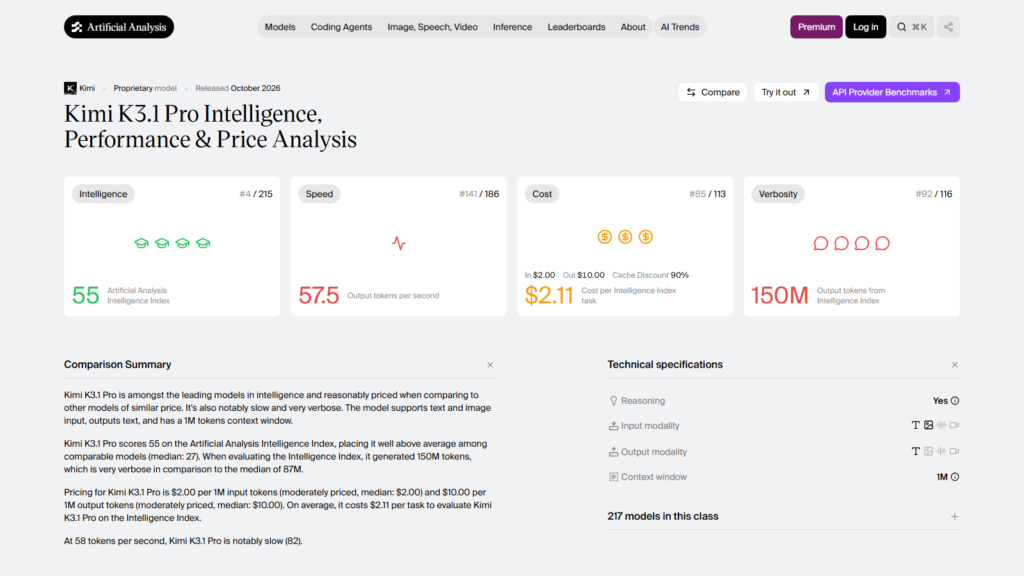
Verbosity. The new model writes more — about 55,000 output tokens per Intelligence Index task against roughly 48,000 for its predecessor [INDEPENDENT]. A model that reasons at greater length has more opportunities to drift from the retrieved evidence.
Effort setting differences in measurement. Both rows are measured at maximum effort, so this is less likely than the other two, but it is the first thing to check with any recall comparison.
What the drop does not mean is that long-context work should stay on the old model. The old model is worse on every other row, costs 50% more per token, and is now flagged as superseded on the independent board. A 2.34-point recall difference inside an 86% score is not a reason to run a deprecated model in production, and if recall is your dominant requirement, the answer is a retrieval layer rather than last generation’s weights.
How to test it on your own documents
Recall benchmarks use synthetic multi-document questions; your corpus is messier. A two-hour evaluation that predicts production behaviour better than any published score:
1. Take twenty real documents of the length you actually process — not synthetic needles.
2. For each, write five questions whose answers are at a known position: first 10%, middle, last 10%, and two that require combining two passages at opposite ends.
3. Run each at the context size you plan to use, and score answers by exact match on the extracted fact.
4. Record cost per question, not just accuracy.
The position breakdown is the part that matters. A model that scores 5/5 on beginning and end and 2/5 in the middle is not a 70% model; it is a 100% model with a known failure region you can engineer around by putting the payload at the end.
The one-line conclusion
Kimi K3.1 Pro has the best long-context recall score in the current field and it is still 2.3 points below its predecessor, which costs more and scores 11.5 points lower overall. Buy it for long context with a retrieval layer and a position-aware prompt, not for the window size alone — and if a deployment depends on a needle at token 900,000, test that needle yourself before you trust the 86% on your own corpus. That test costs one afternoon and replaces an entire benchmark discussion.
Sourcing note: every recall score in the table is Artificial Analysis on index v4.3.2, read 26 October 2026, and includes both Kimi configurations at maximum effort. The post-training description and the 33% price cut are Moonshot’s. Output-token comparisons come from AA’s measurements. The evaluation recipe at the end is ours; it is not a published benchmark.